
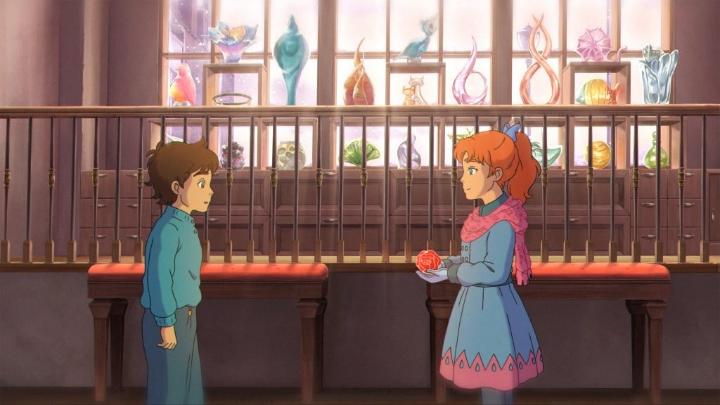
In my screening part of a limited-run theatre release, "The Glassworker" opens with a short live-action documentary-style introduction with Usman Riaz, the director. Edited with clips of a small modern office with smiling, hard-working staff, he states he's the director, co-writer, and composer (cool!) of the movie. He goes on to emphasize that this is the first 2D animated film from his home country of Pakistan, a country "known for many things, but not animation," and that this is the realization of a personal dream 10 years on the making. Its noble, and a well-produced introduction that explains why this film matters... but it'd be more meaningful if this "10 year dream" wasn't led by a boy that barely looked 25 years old. I want to discuss the film, its story, and its quality on its own terms. However, it's unavoidable to not talk about the elephant in the room. This up-start of Gen-Z-aged adults chose, as the style to represent their country's first big production in 2D animation, to go with Japanese anime. Because of course they did. To their credit, they don't go as far as to CALL this movie an "anime" (some hashtag-proud-weeabos would insist on calling their work "anime" or nothing at all, even if they've never been to Japan). But they don't acknowledge the influences either. And of all the styles within anime, "The Glassworker" most directly recalls Studio Ghibli, and more specifically, Hayao Miyazaki. Both in character and environment design, in music (the score is very Joe Hisashi-like), and themes, such as appreciating small details and beauty in everyday things, and even Miyazaki's preference for classical-European towns and strong anti-war messaging, or even the tendancy for the English dialogue to sound British (does this take place in Pakistan or not?). Even that live-action introduction felt like it was ripped straight from one of Ghibli's recent documentaries, such as "The Kingdom of Dreams and Madness." It's easier to take a 73-year-old seriously when he talks about legacy or his film's purpose, much less so when a teenager fresh out of school tries to speak with the same gravitas. I love anime too, and can see why one would want to repoduce it, but I've always been uncomfortable with how obsessed certain groups have become to anime, and through osmosis, Japanese culture, overshadowing interest and appreciation of hundreds of other cultures around the world. Regarding this movie, I'll get past this. But if you're going to blatantly copy a style of film from another creator, it better be at least as good, if not better, or else be subject to extreme scrutiny. And in motion, "The Glassworker" quickly shows its flaws. Frame-count in its animation is limited, not necessarily more limited than a Ghibli movie, but keyframes aren't utilized as well as they should have to convey motion. Some character poses and faces look just a little strange when animated. The script needed editing, and the English voice acting is disappointing, completing missing obvious inflections intended in the line, and mumbling words to the point that it was difficult to hear (I'm assuming none of the cast were trained actors, or that they recorded remotely from home, and the production never bothered to get a second take after providing feedback). There are subtleties everywhere in the production that make it clear that this is not a Ghibli film, and not as good as one.But the subtleties are... subtle. "The Glassworker" barely passes into the uncanny valley, where there's clearly something off about it, but to an untrained eye, it'd be difficult to point out what. In fact, I think a majority of viewers might not notice anything off at all, and would leave thinking this was a lovely animated film. But because of the anime style, a majority of curious viewers of this movie will probably be anime fans... obsessive anime fans... and with this audience in particular, some of them can probably tell. And might be offended with the output, that it would dare to strive so high by copying, but fail to reach its target. Then again, American-produced "anime" (think Nickelodean's "Avatar," or Netflix's "Castlevania" and "Tomb Raider") is now more commonplace, and casual anime fans haven't complained much about that, so maybe I'm in a minority. But I can see the flaws and cracks in the light, and it bothers me. It's clear that the movie was missing only one thing: experience. The production team desparately needed mentors to guide, teach, and correct these minor issues behind the scenes. But as the introduction stated, there isn't a major industry of animators in Pakistan to guide the next generation. It's part of why Japan's animation has been, overall, great, or at least to a certain standard - there's a massive team of older talent to overlook everything. It's why Western countries' animation meets a certain quality, even as the 2D animation sector crumbles, and those experienced mentors slowly retire and pass away. But "The Glassworker" received moderately large attention early in production... I wish some external, experienced staff were able to step in to push things further. It's unfortunate that "The Glassworker" released in 2025, when generative A.I. was sparking fears for the creative industry. Able to now produce not just images, but short animated clips, generating images inspired by Studio Ghibli made headlines. Right now, I don't think A.I. is capable of generating complete movies with the care and quality that Ghibli has done. But it can come close, closer than people realize. What would such a film look like? Frankly, a lot like "The Glassworker." I'm not saying "The Glassworker" made any use of A.I., but when it tries so blatantly to copy a specific style, and gets lost in the uncanny valley along the way, it's not much significantly better than what a machine can do today. And when there's zero attempt to define your OWN style in some aspect (either in visual design, motion, music or story), how can we say that this is any more meaningful than an A.I. film made in someone's basement over the course of a few days? 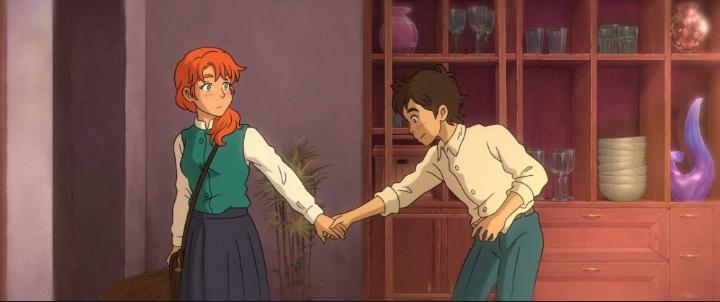 At one climatic point of the story, the two lead characters, lovers, get into a sudden spat: one claims the other, a musician, isn't a "true artist," because they only reproduce instead of creating something new. I had to hold back laughter in the theatre. The entire existence of "The Glassworker" is to reproduce another style without the creative merit of producing something new. Was this a self-referencial, tongue-in-cheek nod by the director, acknowledging they know how some viewers would think of the visual style? Or, more likely, was the entire production team really so tone-deaf, so lacking in self-awareness, that they believed in this message? Yet again, I felt directly offended in the mistakes I was seeing on screen.... it's unfortunate that the choice of style was so distracting to me. Because "The Glassworker" is, ultimately, a good film. For a first directorial debut, it's a good film. For a film to represent Pakistan, it's a very good film. I've talked enough about the movie's influences, let's finally get to talking about the movie itself.Set in a (I assume fictional) Pakistan town, Vincent Oliver is about to showcase his first art exhibition, of blown-glass sculptures. In preparation with his father and mentor Tomas, he comes across old letters from a childhood friend (and lost love) Alliz, and as he reads them, he reminisces about his unbringing and the period he grew up in. Vincent was home-schooled, raised by his single father after his mother's passing, and raised specifically to be a glassworker in his father's shop. And Vincent was fine with that, but also longed to go to school with other kids. A war was brewing with another nation over a far-off plot of land both sides claimed, and Tomas was outspoken in the community for being anti-war and anti-military, which decidedly made him and Vincent unpopular in a community that was proud to see their men fight in uniform for their cause. By chance, young Vincent meets a young Alliz, who, as fate would have it, is the daughter of the military's top general, and its through her that Vincent sees outside his home and workshop with Alliz as a guiding friend. As the war comes closer to home, it also threatens to tear their friendship apart.The choice to make glass the centerpiece of the film is inspired. In animation, it's rendered simply, and when static, rendered with better colour and detail, and beautiful in both cases. The colours and European design of the village (it looks like a quaint Swiss or French town from a century ago) might not look like Pakistan as I imagine it, but there are other cute cultural references, such as clothing-styles or name-dropping foods I've never heard of (please forgive my cultural ignorance). Again, in Ghibli tradition, the food looks gorgeous too. While I'm not as keen about the animation quality, the painterly backgrounds are lovely, and this is overall a beautiful-looking film. The musical score is also lovely, and as a fan of Joe Hisashi, I wonder why more people don't try to reproduce his piano-heavy style more often - here, it strikes me as a good reproduction, even if it wears its influences on its sleeve.I'm usually not a fan of the story archtype that goes "adult thinks back about his childhood, which takes up the whole of the movie." But here, it works fine, because of the romance between Vincent and Alliz, and why we (initially) don't see them together as Vincent prepares for his exhibit. The story goes to some effective directions beyond childhood awkwardness and stubborn parents. Tomas is forced to make a difficult decision against his own morals, and later, the movie takes a suddenly dark and violent turn (reminding me more of Goro Miyazaki's films than his father, but anyway...). It's sudden and shocking, and maybe out of place, but emotionally effective. There's even a little magical realism thrown in for a sense of wonder, in a "magical jinn" who lives in a cave near the glass studio's coastside beach... with particle effects ripped directly from the shooting stars in "Howl's Moving Castle"... ... I just can't help but make the comparisons, can I? The Ghibli style is so entwined with "The Glassworker" that it's impossible to not discuss it. But even while it's the reason for the glaring flaws, it's also the main thing propping up the movie's strengths. If you like Ghibli's art style, you'll like this. If you like Ghibli's stories, you'll like this. If you like Ghibli's music, you'll like this. You won't like it as much, but you will like it. Even if Studio Ghibli passes away with its founding members, I'm not sure I want other studios to replicate, to the letter, their style and stories. I hope Mano Animation Studios doesn't stick with the Ghibli style after "The Glassworker." At least, I hope they find ambition to add a little bit of their own style moving forward. But for whatever flaws this movie had, it was their first movie, and no doubt a big learning experience. Imagine what their second film could look like, or their third. There is potential for greatness to come from them, and like watching a talented student nervously present their project, I'd say "The Glassworker" is a great start, if only just a start. Like any craft, they'll get better with experience.